

Rental Center: When opportunity knocks, Hoosier Tool Rental answers
Steve Lee takes advantage of less-than-obvious rental opportunities.
by Clair D. Urbain
 |
|
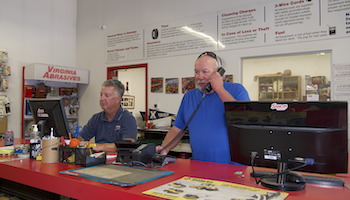
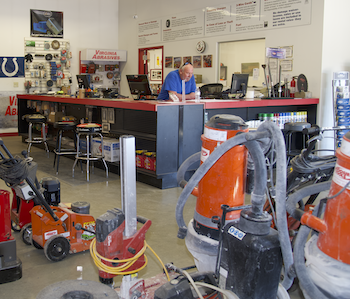
Steve Lee, owner, and Jim Hedlund, general manager, of Hoosier Tool Rental handle online requests and phone calls for tool and equipment rental at its Indianapolis, Indiana showroom. |
 |
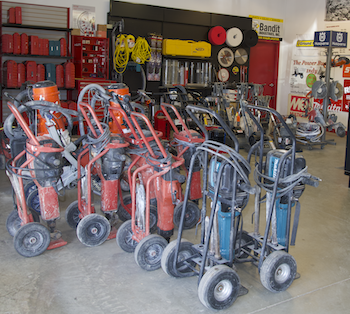
| Hoosier Tool Rental’s fleet is a mix of small- to medium-sized equipment and a variety of power tools used by professionals and DIYers alike. |
 |
|
Corded tools are still mainstays in Hoosier Tool Rental’s fleet. |
From the outside, Hoosier Tool Rental on the near northeast side of Indianapolis, Indiana, looks like a typical equipment rental center. Customers come and go while staff moves, checks in and checks out equipment. Other staff are loading equipment for the day’s deliveries.
The same is true in the showroom. Consistent phone calls are peppered with in-person rental requests, pickups and drop-offs. On the showroom floor, a wide variety of sanders, grinders and jackhammers stand ready to be checked out by customers.
But even with the steady stream of phone and in-person customers, Steve Lee, owner of Hoosier Tool Rental, shares his insight about the rental operation’s past and future opportunities.
“Most of our customers are within a seven-mile radius of the store, but we do have some long-time customers who pick up jobs an hour or more away who rent equipment from us,” Lee says.
His, fleet, made up of small- to mid-sized equipment, is valued at nearly $5 million. “Our customer base is about 75 percent contractors and 25 percent DIYers. The homeowner/DIYers like doing business with us because they get contractor-grade equipment and have access to the same tools that the pros use. Our forte is small- to mid-sized contractors, contractors with five to 15 employees and they may have three to seven jobs working at a time. While they often buy their own equipment, if they put on an extra crew and they need an excavator or skid steer, they come to us,” Lee says.
Lee got into the rental business in 1992 when he and his past contractor-partners were flipping houses in the Indianapolis area. “We were always renting saws or generators or skid steers to flip these houses and we decide to buy equipment and rent it to other people when we weren’t using it. By 1995, I stopped flipping houses and got into the rental business full-time,” he says.
Opportunity knocks
Just as getting into the equipment rental business was part of Lee’s keen sense for opportunity, so was the first time he laid eyes on a Toro Dingo mini loader when they were introduced several years ago. While the Dingo and powered buggies were new concepts at the time, Lee sensed it was something that would catch on with all types of contractors, especially concrete finishers and landscapers.
“The salesman dropped one off here and said I could keep it for a year, and we would split the rental proceeds that the unit brought in during that time. If it didn’t go out on rent, there was no harm, no foul,” he recalls. “I really didn’t know what to do with it, but not 15 minutes later I got a call from guy looking for a small machine that could be lowered into a basement and be used with a breaker and a digging attachment.
“I told the guy that I just got a machine in that can do that. He came right over and looked at it and said it was just the machine he needed, and he’d like to rent it for six months. I called the salesman and told him I would buy it and that I wanted another one right away. We were the only rental company in town that had a Dingo. I had competitors calling me asking about them. Contractors realized that with this type of machine, two guys can do the work of four. Today, we have several of these units and they are never here. They are always out on rent.”
Extending the season
Central Indiana definitely has a winter season and it greatly affects equipment rental, Lee says. “My goal is to maximize the utilization of equipment. While scissor lifts and tow-behind boom lifts are only a small part of our business, they are popular with electricians, tree trimmers, plumbers and drywallers. “If you think that these lifts are built only for tree cutting and painting, you are missing probably another 30 or 40 percent of the market,” he says.
The lifts, particularly the tow-behind boom lifts, are popular with contractors who put up and take down holiday decorations. “If you get to know those contractors who decorate for Halloween, Thanksgiving and Christmas, you’ll be utilizing that equipment for an extra two or three months of the year. Whenever I see a contractor installing holiday lights and decorations, I call them and let them know that if they don’t own a lift, we can rent one to them.”
Because it’s not the prime renting season, Lee can offer attractive rates on those pieces of equipment. “It gets them in the door, and while it’s not our top in-season rate, it’s better than having the piece of equipment sitting off rent. It’s turned out to be gravy at the end of the year,” he says, noting that his business has grown 20 percent each year.
Lee says his business has changed since the COVID crisis. “Contractors are getting better about planning their work and are reserving equipment ahead of time. During COVID, equipment was scarce and the problems with the supply chain made getting more equipment nearly impossible and when you could, prices were 25 to 50 percent higher than pre-COVID,” he says.
While equipment availability has improved and the price of equipment has leveled off, it’s getting harder to make an economic case for new equipment. “Some of our skid steers were close to $60,000 after COVID. It’s getting close to the time to trade those units, and no one is going to give you that extra bump for price increases in COVID, which have come back down some. Your equipment must be really clean and in high demand to get that top dollar to have it make sense,” he says.
Battery-powered equipment
Lee is keeping his eye on battery-powered equipment but struggles to make economic sense of it. “Prices for battery-powered equipment is higher, and for many models, you need several batteries, which are also expensive,” he says. He presently has several battery-powered hand tools – chainsaws, trimmers and other power tools – but he’s not ready to add larger battery-powered tools and equipment to his fleet. “You can’t justify the higher rental rate that battery-powered equipment would have to bring to make it make sense.”
Looking to the future, Lee continues to look for new opportunities. “I have a contractor who is researching composting food waste. No one is doing that in this area, and we are working with them on costs and equipment. It’s not going to happen overnight, but if someone creates that kind of opportunity, it creates opportunities for others and it’s an opportunity for rental,” he concludes.
This article originally appeared in the November-December 2025 issue of Pro Contractor Rentals magazine. ©2025 Urbain Communications LLC. All rights reserved.

PRO CONTRACTOR RENTALS MAGAZINE


Pro Contractor Rentals provides information of value to rental centers who focus time, resources and attention on meeting the demands of construction contractors and other equipment rental customers.