

Rental Center: Betting on what's next
Crown Rental focuses on customer trends to help drive its business growth.
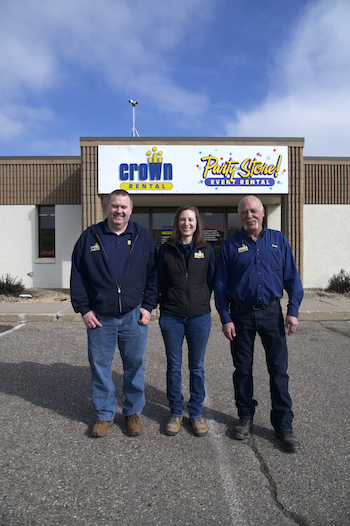 |
| Jeremy Yantes, store manager, Brittany Haas, office manager and Doug haas, owner of Crown Rental in Burnsville, Minnesota. |
 |
|
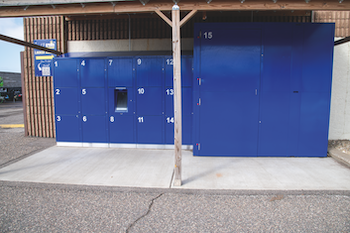
Crown Rentals has installed an American Locker locker station powered by Point of Rental software. It allows 24/7 tool and equipment pick-up and drop-off. It sits just outside its secure gated yard. |
 |
|
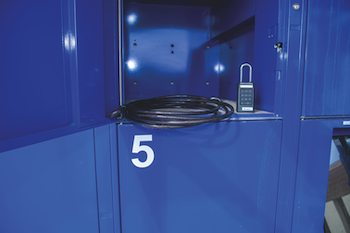
Bluetooth-activated Master Lock padlocks are used to secure equipment to eyebolts installed at the perimeter of the outside yard, allowing after-hours drop-off or pick up of equipment. |
 |
|
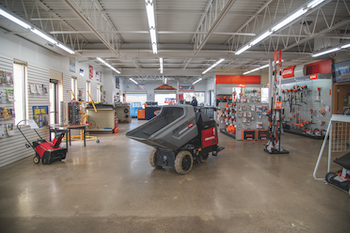
Crown Rental’s main rental center also features small equipment and tools in demand by local customers. |
When he looks back on his beginning in the rental business, it wasn’t part of some grand plan. It was, as he puts it, a search for something better. “I was in the automotive repair business and I got tired of cranky customers,” says Doug Haas, Crown Rental owner. “I was looking for something where I could work on a fleet of equipment and stumbled across an ad for a mechanic at a rental store that was going to open.”
That chance encounter turned into a 37-year-and-counting career and ultimately ownership of Crown Rental, a three-location rental operation serving contractors and homeowners alike in the Minneapolis metropolitan area. From assembling every piece of equipment in the company’s early days to navigating today’s tech-driven, convenience-first environment, Haas has seen the industry evolve in ways few could have predicted.
From one bay to a regional player
Crown Rental opened its doors March 1, 1989, in a modest one-bay shop in Burnsville, Minnesota. While the business was founded by Ron Enright, Haas purchased the business in 2012 and took full ownership in 2016.
Over the years, growth came steadily. As demand increased, the company expanded into additional retail spaces in the building. “We just kept taking over retail units as we needed more space,” Haas recalls. “We moved into this building in 2014.”
That building, now the company’s main hub, spans roughly 50,000 square feet, with an additional yard that doubles its footprint. Crown Rental also operates locations in Rosemount, and Apple Valley, each with its own distinct customer base. The rental center has 16 full-time employees and will grow to a staff of 25 to 30 for the peak rental season.
“Rosemount is a younger, newer development,” says Brittany Haas, Crown Rental office manager and Doug’s daughter. “Apple Valley has a more affluent clientele, which is mostly homeowners who are weekend warriors.”
“The Burnsville location is the main hub,” says Jeremy Yantes, general manager. “We do all the deliveries out of here and all the maintenance comes out of this location.”
Business evolution
Haas has his heart in this business. “I love the rental business. I don’t have any hobbies outside of riding my Harley, and back in the beginning, there were some days that I was here 20 hours a day,” he says. “I still remember our celebration of our first $1,000 day.” Today, that milestone has taken on a different meaning. “Now, it’s a really bad day if we only do $1,000.”
Today, Crown Rental generates roughly $3 million annually, with about $2.4 million coming from equipment rentals and the remainder from party rentals and related sales.
 |
|
Doug Haas, owner of Crown Rental, purchased the business in 2012. |
 |
|
Jeremy Yantes, store manager, says demand for stand-on skid steers is increasing. |
 |
|
Brittany Haas, office manager, uses ChatGPT to carry out marketing efforts. |
Like many independent rental companies, Crown Rental once leaned heavily into event rentals. In fact, the company expanded aggressively into the segment following the 2008 recession.
“We saw our party business growing and our construction business going down,” Haas says. “So I said, ‘Well, let’s use the money and we’ll buy more party stuff.’ At its peak, the party division generated more than $1 million annually. But the economics eventually shifted.
“The labor costs were just killing us,” Haas says. “We decided that anything we had to deliver and set up, we were going to get rid of.” Today, the company still maintains a sizable party/entertainment inventory of chairs, canopies and tables but focuses on smaller-scale, customer-handled rentals. “It’s smaller in scale,” Yantes adds, “We still do 15 deliveries a day during June.”
The seasonal nature of the business also played a role. “It’s typical of the Midwest; we get seven months and then for five months, there’s nothing,” Brittany says.
Finding a niche in a changing market
Crown Rental has carved out a clear niche in the metropolitan Minneapolis area of small- to mid-size contractors and homeowners. “We cater to the small to medium contractor and then homeowners,” Haas says. That focus shapes everything from fleet composition to purchasing decisions.
“We don’t have anything over 12,000 pounds, so we don’t have to get into Class A CDLs,” Yantes explains. The fleet includes mini excavators, skid steers, boom lifts, trailers and a full range of lawn and garden equipment, including woodchippers and stump grinders. But what’s changed most over the years is not just what Crown rents – but what it no longer rents.
“Carpet-laying tools and flooring tools are pretty much nonexistent rental-wise right now,” Haas says. “Everybody’s gone to the click-together vinyl planking.” Even basic tools have faded from the rental mix. “Circular saws and drills were something you’d rent quite frequently,” he says. “Now, everybody buys their own hand tools.”
At the same time, demand has shifted toward smaller, more versatile equipment. “We have noticed much of our demand for larger skid steers has changed to more mini skid rentals,” Yantes says. “Stand-on skid steers that can fit through yard gates are popular with contractors and homeowners alike.”
The slow march toward electrification
While battery-powered tools dominate the consumer space, larger rental equipment hasn’t followed at the same pace; at least not yet. “Contractors aren’t yet sold on it,” Haas says.
“If the job doesn’t say you have to use battery power, at this point, contractors are always going to always choose gas,” Yantes says. Still, Crown Rental has experimented with battery-powered equipment through partnerships and trial programs with Hilti.
“When people come in for the gas-powered tool, we’d also give them the battery-powered tool for free to try it out,” Yantes says. The results have been mixed. “The cutoff saw had good feedback, but with the rotary hammer, nobody ever rented it.”
The hesitation often comes down to one simple concern: uptime. “If it runs out of gas, the renter can add gas and can keep working,” Yantes says. “But if the battery runs out of power, it has to be recharged. That takes time. We’ve had successful rentals of battery-powered jackhammers, but only when we sent out six batteries along with the unit so they could keep working while the other batteries charged.”
Maintenance philosophy: No shortcuts
One area where Crown Rental hasn’t compromised is on maintenance. “For example, we change the knives out after every woodchipper and stump grinder rental,” Haas says. “Everybody’s paying the same amount for the rental, so they should get brand new sharp knives every time.” That philosophy extends across the fleet and has helped the company maintain reliability and in turn, customer trust. “We do it every time,” he says, “We don’t wait until somebody complains.”
Another time- and customer-saver is an automatic chainsaw sharpener that Haas recently brought into its maintenance arsenal. “We used to have one person sharpen chains; now anyone who is trained on this equipment can hang a chainsaw chain on it and end up with a well-sharpened chain while the customer waits,” says Haas. It was an expensive tool, but has definitely made a difference with customer service and satisfaction.”
Workforce realities
Like many businesses, Crown Rental is adapting to a changing workforce. “New hires today expect different things,” Yantes says. “They like being fed and they like recognition that they are making a difference.” Management styles have evolved accordingly. “You can’t just sit in your office. You have to be out there, connecting with them.”
Hiring has also become more complex due to Minnesota labor laws and shifting expectations. “If an employee is under 18, he or she can’t operate or work on any power equipment in Minnesota,” Brittany says. “So we can’t start hiring them for these types of jobs until they’re 18 years old.”
To find new hires, Brittany has turned to online tools. “Indeed has proven to be my best resource and AI has really helped me revamp job descriptions so we get quality candidates. We make it clear that these are physical jobs with customer interaction, not just DoorDash-style deliveries. That has greatly improved our candidate pool,” Brittany says.
Embracing technology and convenience
Technology is reshaping nearly every aspect of Crown Rental’s operations, from hiring and marketing to improving the customer experience.
“My marketing efforts are done with assistance from AI,” Brittany says. “ChatGPT and I work together to do our marketing plan and activities for the next week.”
Perhaps the biggest transformation may be in how customers are evolving to interact with the business. Crown Rental has invested heavily in 24/7 access, including American Lock locker systems and Master Lock Bluetooth-enabled locks that allow unmanned equipment and tool pick-ups and drop-offs.
“A customer can reserve certain tools and equipment online, then go to the lockers and pick it up without having to interact with a person,” Yantes says.
Customers appreciate the convenience, but the concept took years to fully implement. “It took four years to get it where it was completely hands-free,” Haas says. “Every customer that’s used it has loved it,” he says.
The shift to self-service reflects a broader trend, Brittany says. “If COVID-19 taught us anything, it is that people will pay for convenience.” That insight has even influenced pricing strategies. “People will pay $20 to drop it off after hours,” she says. “Plus, it’s allowed us to eliminate being open on Sundays. That’s really a labor savings.”
With convenience comes risk of theft, but Crown Rental has invested in layered security to protect its assets. “We haven’t lost a piece of equipment,” Yantes says since implementing systems for renter ID verification, GPS tracking and video documentation.
The company uses identity verification tools such as Vouched ID that analyze customer data in seconds. “With our rental identification system, we know how long a customer has had an email, a cell phone and how far that customer is from this area,” Haas says. Combined with geofencing and Matrack tracking devices, the system provides real-time visibility. “If a renter takes the equipment outside of our geofence of about 50 miles from our main shop, I get a text and an email,” Haas says.
The company also uses Record360 to check out and check in equipment to identify damage.
Looking ahead
Despite decades in the business, Haas continues to think about what’s next. “Eventually I want to get it where they can rent any piece of equipment without staff interaction,” he says.
It’s a vision he’s had for years, long before the technology existed to support it. “I talked about it at the dinner table for years,” he says. Today, that vision is reality.
While the tools, customers, and workforce may continue to evolve, the foundation of Crown Rental remains the same: a commitment to service, adaptability and doing things the right way.
This article first appeared in the May-June 2026 issue of Pro Contractor Rentals magazine. ©2026 Urbain Communications LLC. All rights reserved.

PRO CONTRACTOR RENTALS MAGAZINE


Pro Contractor Rentals provides information of value to rental centers who focus time, resources and attention on meeting the demands of construction contractors and other equipment rental customers.