

Equipment Insight: Rough-terrain MEWPs Electric units expand indoor and outdoor capabilities.
 |
|
Genie’s latest innovations, highlighted in models like the S-85 XC FE, center on platform performance at height, gradeability and versatility across applications. |
 |
|
Key advances include hybrid and electric drivetrains, enhanced platform controls, advanced diagnostics and integrated telematics. For rental centers, these features translate to increased fleet versatility, lower operating costs and greater appeal across customer segments. |
 |
|
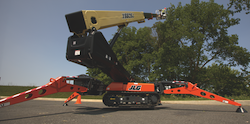
JLG compact crawler boom lifts use tracked undercarriages and automatic leveling systems to navigate soft or uneven ground while minimizing surface disturbance. They can work in environments such as parks, landscaped areas and sloped terrain where traditional wheeled equipment may not be suitable. |
 |
|
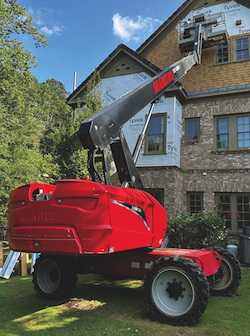
The ability to use and control four hydraulic functions at the same time is appealing and leads to operators requesting Manitou machines as a reliable rental option. |
 |
|
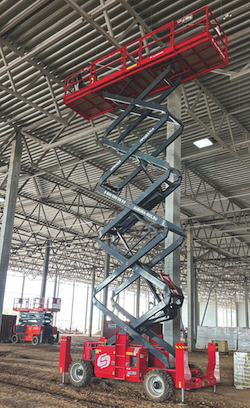
Sinoboom has focused rough-terrain development on improving traction, drivetrain efficiency and stability under real job site conditions. |
 |
|
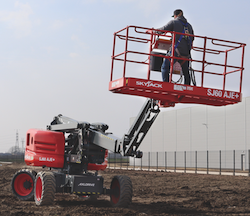
The new articulating booms feature Skyjack’s AxlDrive true mechanical four-wheel drive system with an oscillating steer axle and manually controlled rear locking differential. It offers superior traction and up to 45 percent gradeability. |
 |
|
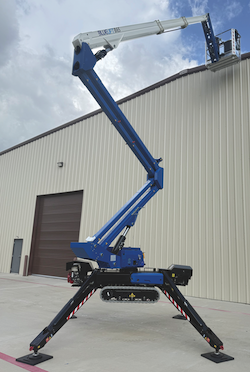
With BlueLift Combo units, rental centers can satisfy both indoor and outdoor rental opportunities with a single BlueLift unit. Plus, they can be transported without the driver needing a CDL. |
 |
| Dominick Damm Director Product Management – Booms Genie |
Greater mobility on rough terain
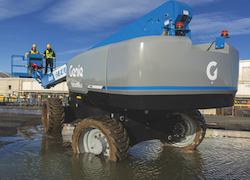
Recent advances in outdoor and rough-terrain mobile elevated work platforms (MEWPs) are focused on one core objective: moving efficiently across challenging job sites. Genie’s latest innovations, highlighted in models like the S-85 XC FE center on platform performance at height, gradeability and versatility across applications.
The ability to maintain a level platform while working at height across rough terrain is an efficiency gain. Genie XC models feature active oscillation even when the platform is elevated. This enables operators to reposition at height without lowering the platform, saving significant time. For tasks like window installation, this can eliminate up to 80 seconds lowering and another 80 seconds raising the platform each time.
Equally important is gradeability on rough terrain. When operators can navigate steep slopes, curbs and uneven ground without detouring around obstacles, productivity increases. Genie XC boom lifts deliver 35 to 45 percent gradeability, allowing operators to move confidently across demanding terrain.
For the most extreme terrain, Genie’s TraX system further expands job site access. This factory-installed tracked option features four independent tracks that improve break-over capability and traction. Oscillating axles and tracks swivel up to 22 degrees that allow each track to climb obstacles independently. TraX systems are available in two frame sizes and offer several benefits, including up to 72 percent less ground pressure compared with wheeled machines, improved obstacle clearance and enhanced climbing ability. It is available on S-45 XC, S-65 XC, Z-62/40 and S-80 J lifts.
These features provide rental centers with machines that match a wide range of applications, increasing utilization. One machine that performs across multiple job site conditions – indoor and outdoor, early construction through finishing – helps customers stay productive while maximizing rental return.
Key examples include:
- XC platform capacity of up to 1,000 pounds and three occupants. This capacity eliminates the need to swap machines during a job. Rental centers can reduce transport costs and get a premium rate.
- Non-marking rough-terrain tires that perform in dirt and mud but remain suitable for finished surfaces.
- FE hybrid technology, combining proven rough-terrain performance and lower operational costs. Genie’s third-generation FE hybrid systems significantly reduce engine hours and maintenance, while Li-ion batteries contribute to lower lifetime ownership costs. By combining rugged capability with electrification, Genie enables higher fleet utilization and broader job site access.
At Genie, ROI is measured as Return on Invested Capital (ROIC) which equals rental rate multiplied by time utilization divided by total cost of ownership. A predictable way to improve ROIC is by reducing maintenance intervals, minimizing parts replacement and increasing residual value at the end of the machine’s first life.
FE hybrid technology is a good example of how Genie helps customers maximize returns. By dramatically reducing engine hours and simplifying hydraulic systems, FE units experience less wear and lower long-term maintenance costs. Add the benefit that FE machines are just as capable on rough terrain as their engine-only counterparts, it’s a financial advantage for rental centers.
In North America, the highest-demand MEWPs are in the 60- and 80-foot straight boom lifts because they align with the majority of building heights and applications. Optimizing fleet mix in this class helps maximize utilization.
While demand is market-driven, utilization depends on how well capabilities are communicated and matched to jobs. Educating customers on performance features, such as gradeability, active oscillation and hybrid flexibility helps ensure the right machine is selected for the job.
With XC and FE models, Genie combines high capacity, rough-terrain performance and flexible power sources into a single platform designed for maximum utilization across diverse job sites. •
 |
| Connor Stanhope Product Manager Access Products JCB North America |
Hybrid models yield benefits
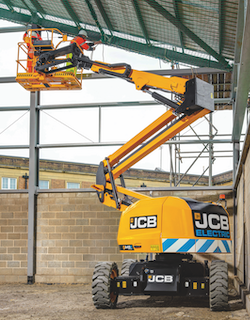
Today’s MEWPs are smarter, more efficient and better equipped to meet the demands of modern job sites. Key advances include hybrid and electric drivetrains, enhanced platform controls, advanced diagnostics and integrated telematics. For rental centers, these features translate to increased fleet versatility, lower operating costs and greater appeal across customer segments.
Hybrid power, for instance, has become a game changer for rough-terrain applications. Models like the JCB A45EH pair a low-horsepower diesel engine with rechargeable batteries, enabling extended off-grid operation. This allows contractors to work in remote or undeveloped areas without relying on site power and can also meet low-emission job site requirements. They can also work through the entire project, from the steel work to HVAC, electrical and fire suppression installation.
Improved diagnostics and telematics, such as JCB LiveLink offer rental operators real-time machine tracking, performance data and maintenance alerts. This helps reduce downtime and supports proactive fleet management. Enhanced safety systems, such as secondary guarding, load sensors and smoother proportional controls also help reduce user error and improve operator confidence.
These advances are helping rental businesses offer more reliable, adaptable and sustainable equipment that performs in a wider range of conditions while reducing maintenance headaches over time.
For rental centers, return on investment in outdoor MEWPs often comes down to versatility, reliability and cost control. Models that perform across multiple applications – construction, industrial maintenance, infrastructure and even indoor-outdoor transitions – tend to stay out on rent longer and deliver stronger margins over time.
Hybrid MEWPs are quickly proving themselves in this category. Machines like the JCB A45EH combine the range and flexibility The JCB A45E and A45EH uniquely combine the traction and capability of a four‑wheel‑drive, rough‑terrain platform with the advantages of an electric powertrain traditionally associated with indoor applications. This positions the machine in a distinct niche – bridging full rough‑terrain performance with clean, quiet operation – while significantly expanding its range of applications. As a result, the limitations historically placed on 45‑foot electric boom lifts are redefined; no longer confined to smooth, flat slab environments, they can now operate confidently across more demanding job sites. This dual-power setup allows the same unit to work on both emissions-restricted sites and remote, undeveloped terrain. It reduces fuel use and cuts idle time, which adds up to lower lifetime costs and greater job site flexibility.
High-capacity platforms can also be a major differentiator. Units rated for 660 pounds, like the JCB A45EH, allow two operators to work with tools and materials without exceeding limits. That reduces setup time, improves productivity and increases the range of tasks the lift can support.
Ease of use is another key ROI driver. Machines with simple, intuitive controls, especially touchscreen interfaces and ergonomic joysticks, help shorten the learning curve. That means less operator training, fewer mistakes and fewer support calls from the job site.
MEWPs that check multiple boxes are the ones helping rental centers maximize fleet value while giving their customers more job options from one machine.
Driving utilization starts with repositioning MEWPs as adaptable, everyday job site tools, not just specialized access equipment. That shift begins by identifying customer pain points: limited access in tight spaces, power constraints or evolving emissions rules. When rental centers match those challenges with the right capabilities, like higher platform capacities, dual-power options or compact footprints, contractors are more likely to see the lift as essential, not optional.
Upselling access equipment as part of bundled solutions is also effective. Pairing rough-terrain MEWPs with complementary rentals, such as power generation, lighting or material handling, can simplify procurement for contractors and keep more of the rental fleet working together.
Operator-friendly features, such as machines with simple controls, clear displays and quick setup, reduce job site friction and training time. that makes them more appealing to a wider range of users. Promoting ease of use, especially for first-time or infrequent renters, helps expand your customer base.
Finally, proactive communication matters. Using fleet data or job site trends to suggest equipment that improves productivity builds trust and positions your team as a resource, not just a rental provider. When customers feel confident in both the equipment and the support behind it, utilization follows.
The JCB A45E and A45EH rough-terrain MEWPs uniquely combine the traction and capability of a four‑wheel‑drive, rough‑terrain platform with the advantages of an electric powertrain traditionally associated with indoor applications. This positions the machine in a distinct niche, bridging full rough‑terrain performance with clean, quiet operation, while significantly expanding its range of applications. What a 45‑foot electric boom lift can do is redefined; no longer confined to smooth, flat slab environments, they can now operate confidently across more demanding job sites. •
 |
| Mirco Negri Senior Product Manager JLG |
New models fit more jobs
Recent advances in outdoor and rough-terrain MEWPs are focused on improving productivity, job site adaptability, sustainability and ease of operation to deliver measurable value to both rental centers and end users.
One of the most significant improvements is full drive-at-height capability on modern rough-terrain scissor lifts. For example, JLG RT and ERT scissor lifts allow operators to drive the machine while fully elevated, enabling continuous work along the length of a structure without repeatedly lowering and re-elevating the platform. This significantly reduces cycle times and improves overall job site efficiency, particularly for tasks such as running utilities, installing exterior systems or maintaining lighting.
Sensing and control technologies, such as JLG’s LiftSense, provide operators with real-time visibility into available lift height and platform capacity based on chassis tilt and load conditions. These systems reduce repositioning, improve productivity and enhance operator confidence while helping customers operate the equipment more efficiently.
Automatic leveling technologies are also improving rough-terrain performance. JLG’s QuikLevel Advanced system can automatically level RT scissor lifts on side slopes up to 4.5 degrees while allowing drive-at-height under certain conditions. Sensors monitor platform load, axle tilt and chassis position, adjusting the machine in real time to maintain stability and maximize usable height on uneven ground, reducing site preparation requirements and expanding where the equipment can be used.
Electrification is reshaping outdoor MEWPs. JLG offers electric rough-terrain (ERT) scissor lifts alongside engine-powered RT models in every size class, giving rental companies flexibility to meet growing demand for low-emission equipment. Electric models help customers work in noise- or emission-sensitive environments while reducing fuel costs and simplifying maintenance. Regenerative braking improves runtime efficiency by recharging batteries during operation.
Terrain-capable boom lift designs are also evolving. For instance, JLG compact crawler boom lifts use tracked undercarriages and automatic leveling systems to navigate soft or uneven ground while minimizing surface disturbance. These features work in environments such as parks, landscaped areas and sloped terrain where traditional wheeled equipment may not be suitable.
Finally, improvements in transportability and setup continue to benefit rental centers. JLG Tow Pro towable boom lifts, available in engine- and electric-powered models, have hydraulic auto-leveling outriggers, compact footprints and highway-speed towing, enabling customers to move equipment between jobs quickly. For rental companies, this means faster turnarounds, broader customer appeal and lower logistics complexity.
These technological improvements help rental centers increase fleet utilization, reduce maintenance and serve a wider range of applications with fewer machines. For customers, they translate into faster job completion, improved safety, easier operation on challenging terrain and more sustainable equipment options, making these outdoor and rough-terrain MEWPs more productive and accessible than ever.
Rough terrain (RT) and electric rough terrain (ERT) scissor lifts offer strong ROI because they can be used on a wide range of indoor and outdoor applications.
Electric rough-terrain scissor lifts further enhance ROI by meeting growing demand for low-emission equipment while offering lower fuel and maintenance costs. This helps rental centers serve both traditional construction sites and sensitive environments with the same fleet investment.
Compact crawler boom lifts also provide strong ROI for rental centers by enabling access in challenging outdoor environments such as soft ground, slopes and landscaped areas where wheeled equipment may not be suitable.
Rental centers can increase demand and utilization of outdoor and rough-terrain MEWPs by positioning modern machines as productivity and problem-solving tools, not just access equipment.
Rental centers can increase utilization by promoting technology that simplifies operation on uneven terrain. Another driver of demand is fleet diversification through electrification. Offering both RT and electric rough-terrain (ERT) equipment models enables rental companies to serve traditional construction sites as well as noise- or emission-sensitive environments.
Utilization can also be improved by highlighting specialty outdoor solutions for soft ground, slopes and landscaped areas, allowing customers to work in environments where wheeled equipment may not be suitable, opening new rental opportunities and expanding use cases beyond standard construction sites.
Finally, rental centers can drive demand by emphasizing ease of transport and setup with certain types of equipment, allowing customers to move equipment independently between job sites, reducing logistical barriers, and encouraging frequent, short-term rentals. •
 |
| Mark Elton Director of Product Management LGMG |
Telematics help fleet ROI
The use of telematics over the past 10 years is a notable trend in the industry. It is a game changer that has enabled rental centers to improve machine uptime and reduce total cost of ownership.
With access to real-time data, rental houses have insights that help them better plan service. They can also monitor machine usage, check overall machine health and track its location. Telematics gives rental houses machine information without dispatching a technician. Armed with error codes and telematic insights, technicians are more prepared when arriving in the field and can easily locate the machine. Issues are identified more quickly and helps reduce downtime.
The availability of electric rough-terrain MEWPs as one of the most exciting and significant technological developments in the MEWP industry. Because electric MEWPs produce zero emissions and operate much more quietly, they are ideal for use on projects with noise restrictions. From the maintenance standpoint, electric machines offer clear advantages with no oil or filter changes required, reducing service time and lower long-term operational cost.
While many of these benefits are especially relevant for indoor applications where emissions and noise restrictions are stricter, there is growing interest from customers working on mixed indoor/outdoor projects. Contractors are recognizing the value of using a single machine that can handle uneven outdoor terrain while also meeting indoor operating requirements. Eliminating the need to bring multiple machines to the job site reduces rental expenses and transportation costs associated with moving equipment, a win-win for the rental house and the customer.
MEWP return on investment (ROI)is closely tied to utilization rate and uptime. MEWP models that support the day-to-day realities of rental operations, by increasing utilization and offering long-term serviceability, are more likely to deliver a higher ROI.
The ideal fleet depends heavily on local market demand, whether driven by data center construction, oil and gas, facility maintenance, warehouse activities or work in commercial facilities. MEWPs that offer greater versatility, such as electric models or machines with higher platform capacities, generally achieve stronger fleet utilization and improved long-term returns.
Driven by tighter spaces and increased access constraints, there has been a clear trend toward smaller, more compact electric machines for indoor applications. In contrast, outdoor projects are increasingly requiring larger work platforms that deliver greater reach and capacity. Rental companies that invest in MEWPs designed with a long service life while matching real-world job site requirements are better positioned to meet customers’ needs, maximize uptime and achieve higher utilization rates.
Electric MEWPs can play an important role in driving utilization. Although electric rough-terrain scissor lifts typically carry higher rental rates, customers are increasingly finding that the overall cost savings and operational efficiency often justify the investment. For rental centers, expanding the number of electric MEWPs within their fleets allows them to offer a more versatile portfolio while strengthening utilization rates. •
 |
| Brian Rabe Product Marketing Manager, MEWP/Forklift Manitou |
Telematics and standards driving MEWP evolution
The two most impactful technological improvements on outdoor/rough-terrain MEWPs have been the integration of telematics packages and the integration of features that meet ANSI A92.2 standards.
Manitou machines feature the EasyLINK telematics module that provides real-time data. It comes with five years connectivity and the customer may share data with Manitou to gain an extra 1,000 hours of warranty on the machine.
EasyLINK provides customers with factory warranty-supported telematics and service, plus access to the MyManitou app. This app allows remote access to active machine information such as fuel levels, run time, maintenance plan and other features. That data can be shared to ensure other operators, fleet managers and supervisors can see what is happening with the equipment.
When Manitou introduced its outdoor/rough-terrain MEWPs that meet ANSI A92.2 standards, operators had to first gain an understanding of what changed with the standards and secondly, how those changes benefit them.
These standards dictate safety requirements for machine functionality and one key feature on the Manitou MEWPs is the platform capacity overload warning. The machines can accurately tell if the platform is overloaded before it starts to work, making it easier for operators to follow best safety practices on the job. They have the confidence of knowing that the machine will help them know if and when they are overloaded or are operating in a potentially unsafe condition. To capture solid ROI with outdoor/rough-terrain MEWPs, rental centers should first have a 50- to 70-foot straight boom and second, an articulated machine in the 40- to 50-foot range. Both can maximize rental opportunities. Manitou offers the standard ATJ 46 and ATJ 46+ models. The “+” models are the most popular rental units and feature standard four-wheel steering with crab steering (2WS/4WS/CRAB). This feature makes these machines the most requested units from operators because they require less repositioning. That can save several hours per week on a job.
The best way to increase the demand and utilization of outdoor/rough-terrain MEWPS is to show a potential customer the value and savings they provide. The advantage Manitou offers are the “+” models. These represent a significant time savings in machine repositioning with the 2WS/4WS/CRAB, as well as a higher capacity of 900 pounds that is unrestricted in the range-of-motion lifting chart. The ability to use and control four hydraulic functions at the same time is also appealing and leads to operators requesting Manitou machines. •
 |
| Kai Meng Product Intelligence Analyst Sinoboom |
Greater efficiency leads to higher performance
In the rough-terrain segment, performance is increasingly defined by efficiency and consistency rather than peak specifications. At Sinoboom, recent rough-terrain (RT) development has focused on improving traction, drivetrain efficiency and stability under real job site conditions. Upgraded hydraulic pumps, more efficient flow management and optimized hydraulic layouts help reduce energy loss and heat buildup, allowing machines to climb more consistently and operate cooler in demanding environments. For rental fleets, this means fewer service issues and more predictable performance across different types of jobs.
Stability on uneven ground remains a top priority for RT customers. Increased suspension travel and reinforced hydraulic cylinders improve wheel articulation and platform stability, resulting in greater operator confidence and productivity. These changes also reduce job site rejection when machines are returned because they cannot handle site conditions.
Telematics and improved diagnostics further support rental operations by giving fleet managers clear visibility into utilization, fault codes and maintenance status. Combined with more accessible service points and standardized wear parts, these help reduce labor time per repair and improve fleet uptime.
A recent example is Sinoboom’s updated 3369RD MEWP, which features new hydraulic cylinders and a revised 4WD hydraulic pump. Together, these changes directly address common RT rental challenges – performance and stability on rough terrain – while helping rental centers reduce avoidable service events.
The best ROI comes from equipment that is easy to operate, in steady demand and quick to turn. Sinoboom rough-terrain scissor lifts that are in mid- to high-working heights are designed to meet these needs. Serving applications from general construction to exterior access and industrial maintenance, Sinoboom RT scissors are specified with 4WD, strong gradeability, durable tires and stable, job site-ready suspensions to deliver consistent utilization and reliable performance across various conditions.
In practice, the strongest ROI comes from equipment that matches the most common job site conditions and minimizes “can’t-do-the-job” returns.
Rental centers can increase demand and utilization by:
- Package the solution, not just the machine. Sinoboom emphasizes supporting the application rather than selling a single SKU. By offering site-ready bundles, such as a rough-terrain scissor paired with a trailer, foam-filled tires and job site protection mats, rental centers make the rental decision easier for contractors.
- Train counter teams to qualify the application. Utilization improves when rental teams take time to understand the job. Ask about ground conditions, slope, access width, required height and how often the machine will be repositioned. Better qualification leads to fewer exchanges and returns.
- Focus on performance outcomes that matter. Sinoboom highlights what crews experience on site. Better traction on rough ground, improved stability and lower heat buildup all contribute to smoother operation and faster job completion.
- Protect uptime through telematics and disciplined service. Uptime remains a key driver of utilization. Using telematics data to guide preventive maintenance helps keep machines on rent longer and reduces unexpected downtime. •
 |
|
Corey Connolly |
New models optimize productivity
The SJ6940 RT delivers the longest working area in the class with a platform that is 14 feet 10 inches in length with the roll-out deck extended. An oscillating front-steer axle tackles tough job site terrain and auto-leveling outriggers (optional on ANSI/CSA models, standard on CE/AS models) maximize usability.
Skyjack takes pride in designing for rental and builds machines that optimize productivity. The SJ6940 RT scissor lift offers outstanding performance and an impressive capacity to support more people, tools and materials. It features 4-wheel drive with wheel motors, torque hubs and an oscillating front axle, providing superior traction, maneuverability and 35 percent gradeability. This ensures mobility across challenging terrain.
The SJ6940 RT is purpose-built to outperform in rough terrain conditions. Skyjack’s four-level scissor stack with a single-cylinder design significantly reduces leak points and simplifies maintenance. Paired with Skyjack’s intelligent adaptive drive system, this rough-terrain scissor lift consistently delivers reliable performance in rugged environments. In keeping with Skyjack’s commitment to sustainability, it has an engine that is HVO compatible and offers a dual fuel option in North America.
Skyjack’s range of hybrid and all-electric rough-terrain articulating booms provide a clean, quiet and sustainable rental solution that features low or no emissions, lower operating costs and increased utilization. Rental companies and contractors can rely on the all-electric zero-emission productivity of the new SJ45 AJE+ and SJ60 AJE+ and the hybrid-electric flexibility of the new SJ45 AJHE+ and the SJ60 AJHE+. Skyjack has designed these articulating boom lifts to meet true job site performance expectations, including navigating rough-terrain conditions. They have been developed without compromising specifications, features or performance found on diesel machines. The Skyjack range has common specifications, parts, capacities, reach and dimensions across all-electric, hybrid-electric and diesel options so rental companies can choose preferred power within a single machine.
The new articulating booms feature Skyjack’s AxlDrive true mechanical four-wheel drive system with an oscillating steer axle and manually controlled rear locking differential for superior traction and up to 45 percent gradeability. This industry-leading terrain capability means one can use Skyjack boom lifts in the most challenging of conditions. With 1,000-pound capacity, intuitive EasyDrive direction sensing, SkyRiserstraight vertical line travel, and SpeedyReach (for SJ60 AJE+ and SJ60 AJHE+), users will find enhanced productivity on job sites. Machine operating efficiency allows for multiple days of work on a single charge; bulk charging on hybrid machines can be completed in less than three hours. Skyjack booms are known for a superior driving experience, a consistent, multi-function capability and machine reliability.
All Skyjack products are designed to be easy to service and maintain. By keeping the design simple, and using proven technology, reliability and ease of service is common to all Skyjack products. Skyjack machines offer the rental industry’s best lifecycle value through low cost of ownership and ease of service and maintenance, all while retaining high residual values. •
|
Alden Cleveland |
Hybrid units offer extended rental potential
One of the greatest innovations in rough-terrain MEWPs is the continued adoption of hybrid technology.
It gives even outdoor users the ability to be increasingly conscientious of the environmental impact their equipment.
Many large contractors have net zero goals and many communities are taking a closer look at outdoor equipment when it comes to emissions.
BlueLift units are powered with lithium batteries or gasoline or diesel engines, depending on customer preference, which can help users reduce their carbon footprint.
Other technological innovations evolve around user controls and diagnostics. User controls are adapting to a new generation of users who are much more familiar with technology, joystick controls, electronic sensors and computer interfaces.
The new BlueLift systems that’s found on the B65 combo tracked articulating boom lift, can be diagnosed in the field by using a laptop computer tied directly into the unit’s onboard systems. For customers, this is a valuable addition to the service capabilities of their teams.
If an issue can be diagnosed and solved while on a job site, that maximizes uptime and reduces costs.
Another trend is the increases in the height-to-reach ratio, giving rental customers greater capabilities in more compact, lighter equipment.
There are many outdoor areas where lightweight equipment can be far less damaging to sidewalks, hardscapes, delicate landscapes or where access is very limited.
BlueLift units are small enough to drive through a standard gate and still achieve amazing working heights.
BlueLift units, of all working heights, are incredibly profitable for rental centers.
There has been increasing demand for compact, lightweight, maneuverable equipment that can get into back yards, or tight spaces on construction sites and can be transported without a CDL.
Utilization is the key to profitability. Time and dollar utilization are important factors to the bottom line and MEWPs are a great piece of that puzzle that can greatly augment a rental center’s fleet mix.
BlueLift units are easy to operate, which gives the rental center confidence that customers will be able to operate the equipment independently.
Another benefit is the hybrid technology on BlueLift units. It’s key that rental centers need to keep their capital expenditures to a minimum while balancing that against the right fleet mix for their market.
If they have only battery/lithium powered units, the will lose many outdoor opportunities; but if they have only gasoline/diesel units, they will lose the indoor opportunities.
With BlueLift Combo units, both market opportunities can be satisfied with one BlueLift unit.
Rental centers need to leverage the manufacturer’s expertise, knowledge and capabilities to have a successful rental and sales program. BlueLift provides the sales application training, user/operation training, service technician training and will work closely with the rental center’s personnel so they’re confident with the equipment.
In the equipment sales/rental world, people will sell what they know. If a salesperson is not comfortable or confident in their ability to talk about a piece of equipment, they probably won’t. They need to know what to look for, what questions to ask and what applications fit the equipment. •
This article originally appeared in the March-April 2026 isue of Pro Contractor Rentals magazine. © 2026 Urbain Communictions LLC. All rights reserved.

PRO CONTRACTOR RENTALS MAGAZINE

Pro Contractor Rentals provides information of value to rental centers who focus time, resources and attention on meeting the demands of construction contractors and other equipment rental customers.