

Rotating telehandlers
The Merlo ROTO 50.30 and 50.35 rotating telehandlers combine reach and rotation, along with attachment versatility to give rental fleets greater flexibility from a single asset.
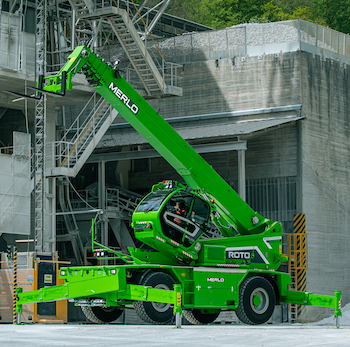 |
| The Merlo ROTO 50.30 and 50.35 rotating telehandlers combine reach and rotation, along with attachment versatility to give rental fleets greater flexibility from a single asset. |
“The whole concept for our ROTO series is application driven. What a contractor needs on one job is rarely the same for another, so the ability to configure the machine around the work with ease and efficiency is incredibly important,” says Rick Fernandez, Product Manager at Merlo America.
One machine, many jobs
The ROTO’s versatility starts with what can be fitted to its boom. With more than 100 different variations of attachments, the machine can move beyond conventional material handling into a varied range of tasks including elevated access, rooftop lifting, tree work and pipe handling. Changing the attachment effectively changes the role the machine can perform, allowing rental fleets to offer customers a broader range of capabilities from just one green machine.
“The real advantage is having one machine that can do many jobs. The attachment you put on the boom changes what the machine can do, so you’re able to match the equipment to the application rather than having a machine that is limited to one type of work,” Fernandez adds.
That flexibility is supported by the ROTO’s attachment recognition system. When compatible Merlo attachments are fitted to the end of the boom the machine recognizes the attachment and automatically updates the load information displayed in the cab to reflect the attachment and machine configuration in use. For rental customers, that adaptability can be particularly useful. Instead of selecting equipment based solely on the primary task, the machine can be configured around the wider demands of the project.
Reach when you need it; size when you don’t
However, versatility extends far beyond the number of attachments a telehandler can use. The physical characteristics of the machine also determine where it can work and what it can accomplish. The ROTO 50.30 and 50.35 offer the same maximum lifting capacity of 11,000 pounds, while providing different combinations of reach and machine dimensions. The 50.35 offers a maximum reach of 111 feet 6 inches, while the 50.30 reaches 95 feet 8 inches in a more compact package. That gives fleets an opportunity to match the machine to the site rather than automatically stepping up to the largest available model.
“What matters is having the right combination of capacity, reach and machine size for the job. The 50.35 gives you that extra reach when you need to get higher or farther out, while the 50.30 gives you the same 11,000-pound lifting capacity in a more compact size,” says Andrew Revels, technical support specialist at Merlo America. In rental, that distinction can matter when machines are being sent to sites where access and available working space are just as important as lifting capacity.
Designed around job site realities
The realities of a job site can make machine positioning as challenging as the work itself. The ROTO series addresses this with an in-line stabilization system that allows its outriggers to extend outward before deploying downward. This enables the legs to be positioned according to the space available, giving operators greater flexibility on confined or congested sites. The outriggers can be positioned manually or deployed automatically, while the machine’s frame-leveling system ensures safety by maintaining a level working platform during setup.
“Being able to position a ROTO’s legs where you need them is a big advantage,” Revels says. “You’re able to set the machine up around the job site rather than having to work around a fixed setup.”
The operator environment is equally adaptable as the ROTO’s cab can tilt by up to 20 degrees, improving visibility of the load when working at height. Configurable load-chart parameters also allow operators to set limits around obstacles such as overhead power lines, buildings and other structures, helping define the machine’s working envelope. The system also takes the attachment and outrigger configuration into account, providing the operator with load information specific to the setup in use.
Making one asset work harder
A machine has to earn its place in a rental fleet, and its value grows with every application it can take on. The ability to move between applications gives the ROTO more opportunities to stay working and helps fleets get more productive hours from a single asset. That broader application potential can also have a direct financial impact, says Fernandez.
“The biggest advantage from a financial standpoint is the number of applications one machine can cover. Instead of needing a different machine for every task, you can configure the ROTO for the job in front of you,” he concludes.

PRO CONTRACTOR RENTALS MAGAZINE

Pro Contractor Rentals provides information of value to rental centers who focus time, resources and attention on meeting the demands of construction contractors and other equipment rental customers.